Behind the Digital Curtain
These days, publishing rules require full disclosure. If a book or other piece of writing is AI-assisted, either in the planning, the writing, or in the editing, then you have to say so right up front.
I’m all for that! I believe that’s a wonderful idea.
In fact, I’m going even further. My whole statement is front and center: AI is an essential feature of my work; I say so, loud and clear.
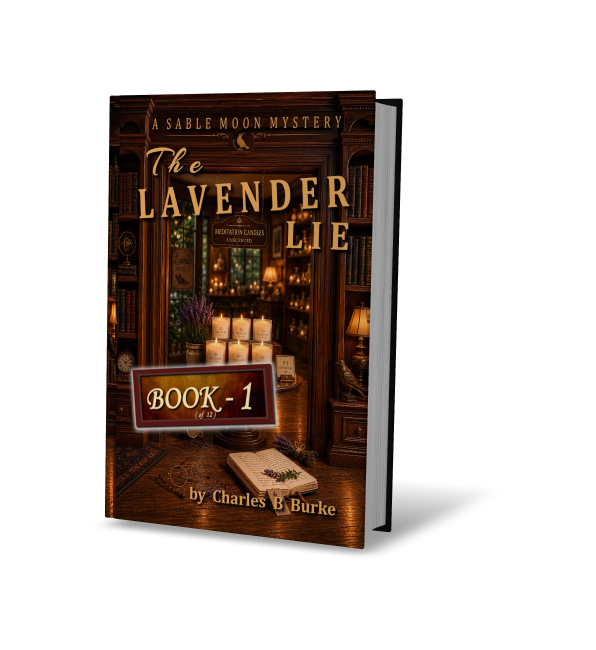
In producing my most recent book, The Lavender Lie, AI was actively used in the plotting/planning stage, the writing stage, and to some extent in the polishing stage as well.
Of course, as a professional editor with 25 years experience, I brought my own writing and polishing skills to bear on every step of the process, too.
Further, to guarantee full openness, I share with you, right here on this page, several of the details involved in my AI-based production process. I’ll even let you in on a few of the secrets why this works better than I ever expected it to, when I first began.
Now, I’m pretty sure you’re a cozy mystery reader like me. And since that’s so, I’m guessing that you (also like me) value straight-from-the-shoulder frankness as much as you value intricate and clean mystery plots.
But at the same time…
In the back of your mind you might also be wondering:
But WHY, Burke? You write just fine without AI. Why use it at all?
Because it turns out that when it’s used right, when it’s used with brain and heart, AI is not just good. It’s amazing.
Truthfully, the percentage of the story that ended up being AI written was much higher than I originally planned because the writing was… well… it was way better than I expected going in.
So out of curiosity, I ran sections of the story through AI detectors, and, frankly, their verdicts were all over the place. They ranged from 100% AI all the way down to 0% AI.
Seriously.
But then, to be fair, I also AI-checked several chunks of my own writing from one of my books back in 2002. And those pristine chunks of my own writing ranged from 0% to 62% AI. That’s why I now have very little faith remaining in AI checkers. They really don’t have much to offer.
So, right here, front and center, I offer no apologies. You’ll never catch me shuffle-footing around and pretending that “those dreadful AI things,” they never happen around here.
And since you like stories, here’s one I know you’ll enjoy. Here’s how this AI stuff first began at my house.
The Story
I had already tried five or six different AI services. They all assured me that they would write a book for me. All I had to do was click the mouse, press the button.
And it was true… sort of. I did end up with books. Seven of them. But every one was… well… anemic.
- Twelve or thirteen chapters per book
- And each chapter was only 1,000 to 1,500 words long
- Plus, the plots were simple little straight-line affairs
- Then, in the very next book, several of those characters would reappear, with the exact same names… and die the same way, all over again
By the way, if you’ve read even a few cozy mysteries, you’ll probably already recognize that a book with only 12-13 chapters and chapters of just 1,500 words — those stats just won’t total up to a good, robust novel.
They won’t even get it halfway there.
And so far, my little story sounds more like a strong argument AGAINST AI. And so far, you’d be right.
But then, I wondered what would happen if I did things differently. What if, instead of abdicating to AI, maybe I could take MORE control over what happened during the process? What if I didn’t just leave it all up to AI, and did a little supervising instead?
So, I changed something
The next day, I showed up at ChatGPT with a massive prompt (instructions).
This new prompt specified EVERYTHING in detail, from writing style, tone and pace, to character names and personalities, to plot direction, a dizzying web of overlapping subplots (yes 6 separate levels of sub-plot keeping their own intrigues going through each and every one of the 44 planned chapters, and kept tracking them all through the novel), and a plan for feeding back ongoing reminders about character history, updated each chapter, as well as event histories, etc., to prevent story drift or sudden continuity leaps.
In other words, I took over many of the jobs that most folks just leave for AI to do.
And — son-of-a-gun — the results, right from chapter one, were far beyond anything I had seen in those first seven so-called “books.”
That’s why I am not embarrassed to tell you openly and plainly:
Yes, I do use AI… and proud of it. I invite you to click to the sample page and read the first chapter of The Lavender Lie. See for yourself the style, the pacing and the personality of Sable Moon, Briar’s Hollow, and Sable’s close circle of lifetime friends.
One more thing I invite you to notice. I don’t use AI to cut corners or do lazy writing. I use it as a high-powered engine to build intricate, fascinating, and deeply intriguing mysteries.
I’m convinced that AI will never function as a high-powered engine for any person who is a low-powered loafer trying to shunt all the work off on somebody (or something) else. AI just won’t give you its best work in that mode.
Because, like everything else in life, you tend to get out what you put in.
Look at it this way: AI didn’t imagine Briar’s Hollow.
AI didn’t invent Sable Moon.
AI didn’t decide that ordinary people, quietly preserving one another’s memories, would become the heart of this cozy mystery series.
Those choices came from me, the author.
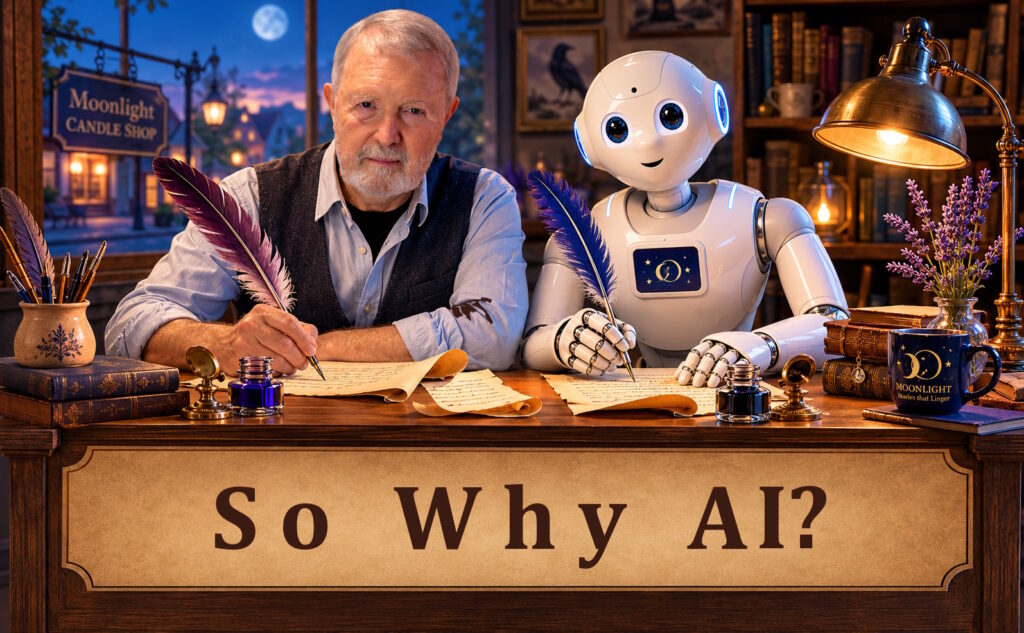
AI did, however, turn into the best brainstorming partner I’ve ever had.
Cheers from Charles in Sunny Japan,
And best wishes from Sable Moon herself.